Video Description
Part 1: What Are Critical Components? MedicalRegs.Com
A critical component is the failure of a component, whether electrical or non-electrical, which can result in an unacceptable risk. Include possible component failures in your risk assessment.
In terms of electrical components, these are components that are exposed to voltages greater than
Safety Extra-Low Voltage (SELV). (SELV – inherently safe from electric shock)
However, a safety component regardless of operating voltage used for risk mitigation is a critical component.
Let's consider an interlocking guard assembly as an example. When someone opens the guard enclosure, the system stops or disables the hazardous part.
The interlock switch rated at 12/24Vdc (SELV) detects the guard enclosure state (open or close).
The combination of interlock switch and guard enclosure prevents access to hazardous parts (i.e., thermal, moving parts, radiation, etc.).
The interlock switch provides an input signal to the processor/PLC and removes the hazardous condition when an open state exists.
In the above example, the construction and materials of the guard enclosure are also critical components.
The guard construction shall withstand impact forces and resist environmental effects that will degrade the integrity of the guard.
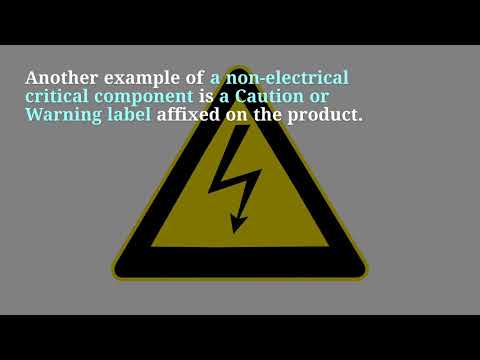
Another example of a non-electrical critical component is a Caution or Warning label affixed on the product.
The label is risk mitigation to inform or create awareness of potential hazards.
The label material shall remain intact on the surface, and information on the label remain legible throughout the operating life of the product.
Critical components are particularly identified in the certification report.
The agency will conduct a quarterly or yearly follow-up inspection to verify if the critical components in production are the same as in the certification report.
Stay tuned for Part 2: "What are the Key Requirements for Critical Components"?
Clarity MedicalRegs.com