Video Description
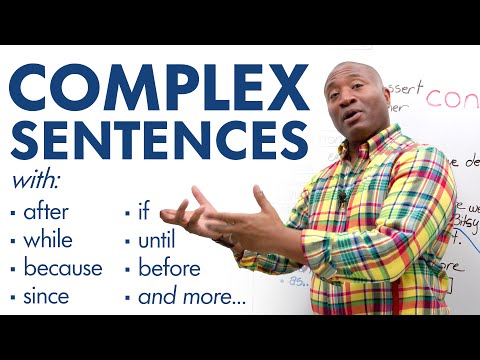
Do you feel stuck in English? Do you want to communicate at a higher level? In this English grammar lesson, I’ll show you how to level up from simple to complex sentences. You’ll learn about dependent and independent clauses. You’ll understand how to use subordinating conjunctions—words like “because,” “although,” “while,” “before,” “after,” “unless,” and “since”. These new words and structures can transform simple ideas into complex, meaningful sentences. Add extra information to your sentences, clarify relationships, and give your speech depth. Join me and learn to speak and write in a more advanced way, for greater academic and professional success. https://www.engvid.com/how-to-use-subordinating-conjunctions-for-better-english/
More of my English grammar videos:
Learn English Prepositions: BY, UNTIL, TILL... https://youtu.be/jYyC-HDdNb8
English Grammar: Correlative Conjunctions https://youtu.be/XYYUXskbX_c
In this lesson:
0:00 How to use subordinate conjunctions in complex sentences
4:11 cause/reason
5:22 condition
6:14 contrast
8:16 comparison
9:41 purpose
10:37 time
TRANSCRIPT:
Hey, E, you having a problem with complex sentences?
You don't know what they're for?
You don't know what they are?
Hi.
James from engVid.
This lesson is about subordinate conjunctions in complex sentences.
I know that's a big mouthful, but if you're an intermediate student to an advanced student,
you need to know this.
When we first learn English, or when you first learn English - me too, I guess, yeah - you
learn the simplest sentence ever, which is S-V-O, subject, verb, object.
I like ice cream.
He plays soccer.
It's a simple idea, one idea, and it's the basic...
The basis of the language, yeah?
But once you get bigger, you don't say "I like ice cream", "I play soccer".
You say more than that.
"I like ice cream because it tastes good", or "When I get home, I'll have some ice cream".
What?
Morse words?
Well, yes.
Because we have complex brains - complex sentence - we have complex sentences, which means it's
a sentence that has an idea and something that helps give you more information about
that idea.
So, we go from the subject, verb, object - very simple things, right?
Yeah?
And then we say "And here's some more information about that thing we're talking about", which
does two things.
It gives us information that we want to have, and it makes the sentences much more interesting.
As I said, "I like soccer", and "I eat ice cream", and "I live here", and "I go to school".
I want to shoot myself, okay?
But "I enjoy eating soccer while I'm watching something on the television", and I...
Also, "Whoa, what happened?"
Same thing.
Now it's interesting.
So, we want to think of a complex sentence which is a basic idea, you know, basic sentence,
subject, verb, object, and we add information to it.
Okay?
And today's lesson we're going to go through...
Well, this is E's idea.
He's got a concept.
A concept is an abstract or a general idea, and E's playing a game here to help you remember
all of the ways that we use subordinating conjunctions to make complex sentences.
These are special words that tell us which part of the sentence is adding information
to the basic sentence.
Are you ready?
Let's go to the board.
All right, so we're going to use one of my favourite people in the whole world as an
example on this one, Bitsy.
Hi, Bitsy.
Okay, so concept.
Concept, as I said, is a general idea, so we're going to say, "Well, what is the concept?
What is the general idea?"
Well, some of you have played this game, and my friend I work with went, "You know, most
of these people don't speak English, so they don't play this game", and walked out of the
room.
It was embarrassing.
He has a point, so hopefully you've heard of it.
It's a girl...
Girl.
It's a game called Scrabble.
We have this game, you know, in English-speaking countries where we take these pieces of wood
with letters on them, and we mix them around and we make up words.
When we make up the word, it's a real word, and you can get points and win the game.
In this case, we're using the Scrabble pieces to help you with this concept, and the concept
is subordinating conjunctions.
And let's get started.
"Con" in Latin means "with" or "together".
Okay?
"Sept" is our idea we're putting together, and the first, and we have C4 because there
are four things we want to talk about.
I'll just label them so you know which are the four, so we've got 1, 2, 3, and 4.
The four Cs will start with a reason or a cause.
Next, we use these words to show what we call the dependent clause.
Remember I told you "SVO" is the basic part of the sentence?
We would say that's the independent clause.
"I like ice cream" is a single idea, and we work from that and we can add. […]