Video Description
🎶Discover the full album "Music of the Heart" on Youtube: https://youtu.be/XGONQBI2Hdo
🎧Find it on all major platforms: https://bfan.link/music-of-the-heart
🎵Stream the track on all major platforms: https://bfan.link/schumann-3romances-op21-no1-andante
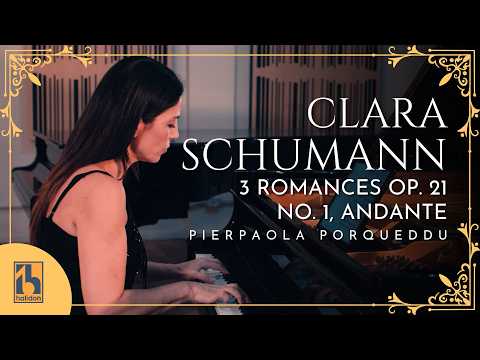
Clara Schumann: 3 Romances Op. 21 No. 1, Andante
Performed by Pierpaola Porqueddu
3 Romances Op. 21 No. 1, Andante
Fanny Mendelssohn’s Nocturne, H. 337 is a jewel of intimate piano composition: gentle, lyrical, and reflective. A flowing accompaniment supports the tenderness of the melody, which unfolds like late-night thought — glowing and soft, but also bittersweet, succeeding in expressing the complexity of experience. It’s the kind of piece that doesn’t rush ahead, but lingers invitingly. All we can do is listen closely to every nuance and breath.
Clara Schumann
Clara Schumann (1819–1896) was a German pianist and composer widely regarded as one of the greatest performers of the 19th century. She began touring publicly as a child in Leipzig, trained by her father Friedrich Wieck, and had already built an international reputation before she turned twenty. As a performer she was genuinely transformative, helping to establish the modern model of the solo recital — serious repertoire, played from memory, with interpretive depth over virtuosic display.
Yet her story is also one of structural friction. Her marriage to Robert Schumann brought both creative partnership and practical constraint: she continued to perform and compose while raising eight children and, increasingly, managing the household's finances as Robert's health declined. After his death in 1856, concert performance became her primary livelihood — a decades-long touring career that was almost unprecedented for a woman of her time. Composition, which she had practised seriously since childhood, became harder to defend and sustain. She often expressed doubt about her right to compose at all, internalising a cultural message that it was a male domain. Much of her output — piano pieces, songs, a piano concerto written at sixteen — was completed before she was thirty.
Her relationship to the men around her — father, husband, Brahms — also shaped how history received her. She devoted enormous energy to editing and championing their music, and that curatorial labour, real and skilled as it was, meant her own creative identity was consistently framed in relation to theirs. The irony is that she outlived nearly all of them, spending her final decades as a celebrated teacher in Frankfurt and leaving a lasting imprint on how an entire generation approached the piano.
Reclaiming Clara Schumann today means looking past the "devoted wife" narrative her early biographers favoured, and recognising the full scale of what she built — a sixty-year performing career and a genuine compositional voice — achieved despite, not because of, the structures around her.
Pierpaola Porqueddu
Pierpaola Porqueddu was born in Nuoro, Italy, in 1976. At the age of twenty, she graduated with top marks from the 'Palestrina' Conservatory in Cagliari. In 1996 she won the first prize at the Città di Camaiore competition. She was chosen by the Conservatorio Palestrina to perform Brahms' Concerto No. 1 at the Teatro Comunale in Cagliari under the direction of Maestro Sanna. The same concert was performed again with the Camille Saint-Saens chamber orchestra. In 1997 she studied at the Accademia Chigiana in Siena with Paul Badura-Skoda. The following year she won the first prize at the National Piano Competition in Cesenatico and the first prize at the International Piano Competition Premio Caffa Righetti in Cortemilia. In 1999 she won 1st prize at the Città di Verbania and Città di Montescudo competitions. In 2000 she won the Castiglion Fiorentino Competition, which gave her the opportunity to study at the Mozarteum in Salzburg in July 2000. She also won the 38th edition of the prestigious International Piano Competition Arcangelo Speranza in Taranto.
C &P Halidon Srl - all rights reserved
#ClaraSchumann #Schumann #WomenInMusic #WomenComposers #RomanticEra #ClassicalMusic