Video Description
Start your free two-week trial of BWS+ here:
https://bws.plus/18a
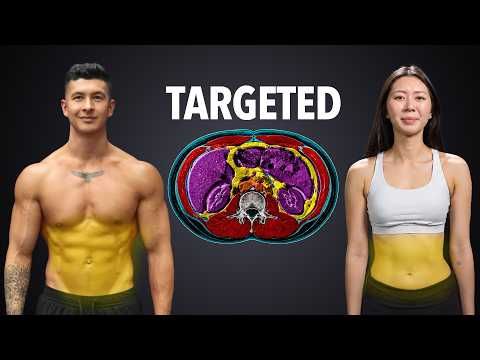
Can you actually target belly fat? For 60 days, we put the most popular belly fat workout advice to the test — running a real experiment on how to lose belly fat using exercises to lose belly fat like targeted ab training, and measuring every result with MRI, one of the most precise ways to track changes in fat and muscle. If you've ever wondered whether belly fat loss exercise routines actually work, this is the clearest answer we could produce.
The idea comes from newer spot reduction research suggesting that training a specific muscle may increase blood flow and fat mobilization around that area. But releasing fat from storage is only half the equation. If your body doesn't actually burn that fat afterward, it can simply be stored again. That's why the protocol combined moderate-intensity cardio with direct ab training, rather than relying on crunches alone.
The experiment followed Dennis and Vicky, both active but struggling with belly fat covering their abs. Dennis started at 17.5% total body fat, with his belly at 16%. Vicky started at 31.8% total body fat, with her belly at 24.7%. To track their results more accurately than progress photos, we used MRI to measure fat thickness across the upper, middle, and lower belly, along with ab muscle size.
For the first 30 days, Dennis and Vicky followed a plan based closely on the 2023 spot reduction study: 25 minutes of moderate-intensity cardio followed immediately by direct ab training every other day. This belly fat workout included weighted crunches for the upper abs and reverse crunches for the lower abs. Diet was not changed, matching the original study design. The major difference was that Dennis continued his usual lifting routine, while Vicky was not weight training.
Visually, Phase 1 looked promising at first. Dennis felt like his abs were becoming more visible, and Vicky noticed more upper-ab definition. But lighting, posing, and day-to-day changes can make progress photos misleading. That's why the MRI data mattered.
After 30 days, Dennis gained about half a pound while dropping from 17.5% to 17% body fat. But his belly fat barely changed, dropping by only about 0.3%. Most of his fat loss came from areas like his arms and hips. Vicky lost 5 pounds, but 60% of that weight came from lean mass and only 40% came from fat. Her body fat percentage moved from 31.8% to 31.5%. Her upper belly did lose fat, but across her whole body, the belly fat reduction was proportional to fat loss in other areas. In other words, the exercises to lose belly fat that we tested didn't pull fat specifically from the belly.
The most interesting Phase 1 result was ab growth. Dennis' abs grew by about 20% on average, and Vicky's abs grew by about 15%, even though she lost muscle in every other muscle group. This may explain why both looked more defined under the right lighting.
For Phase 2, we threw out the spot reduction protocol completely. No cardio. No direct ab training. Instead, Dennis and Vicky focused on tracking calories and strength training. Vicky started a 3-day full-body workout plan, while Dennis followed a 4-day upper/lower split.
Cardio was removed for a reason. After cardio, people often eat more or move less without realizing it, which can reduce the expected fat loss. That doesn't mean cardio is bad — it has real health benefits when used correctly — but in this experiment, diet and lifting were tested independently.
The difference was dramatic. In Phase 2, Vicky's body fat dropped from 31.5% to 27.5%, and she gained almost 3 pounds of lean mass while losing weight. Her belly fat dropped by an average of 30%, including a major drop in her lower belly fat, which had not changed in Phase 1. Dennis lost 6 pounds, dropped to 14.4% body fat, and reduced his belly fat by an average of 26.3%.
There was one tradeoff: without direct ab training, Dennis' abs shrank by about 16%, almost back to where they were before the experiment. Vicky's abs mostly maintained their new size, likely because she was a beginner and full-body strength training gave her enough indirect ab stimulus. So while diet and lifting clearly beat the spot reduction protocol for belly fat loss and overall body composition, direct ab training still helped build the abs themselves.
The final takeaway on how to lose belly fat: based on this 60-day MRI experiment, trying to target belly fat directly did not work better than regular fat loss. The best belly fat loss exercise approach turned out to be calorie tracking, strength training, and protein-focused meals to lose fat while maintaining or gaining muscle — not endless crunches.
0:00 - 4:47 How "Spot Reduction" Works
4:48 - 10:10 Phase 1 Experiment
10:11 - 13:06 Phase 1 Results
13:07 - 20:24 Phase 2 Experiment
20:25 - Phase 2 Results
Click below to subscribe for more videos:
https://www.youtube.com/jeremyethier/?sub_confirmation=1