Video Description
I recommend three life-changing books and give you a simple system to turn them into your own personal curriculum. I’ve shared WHY reading helps you improve all four skills – now let me show you HOW. First, find your big “why” with Jonathan Livingston Seagull, then master small, consistent habits with The Kaizen Way, and finally execute your plan in focused sprints using The 12-Week Year. I’ll walk you through exactly how to apply each approach so you can read smarter, learn faster, and actually reach your goals. Watch now and start building your ultimate learning plan! More importantly, you can go and read other books and use them in a similar way to make a system that’s perfect for you. https://www.engvid.com/3-book-formula-success/
Make sure you've also seen my "Read More & Learn Faster" video: https://youtu.be/W6Z94ffQx3s
Another book with important lessons about learning: https://youtu.be/-YTBQH_bPD8
In this lesson:
0:00 Introduction
1:46 Jonathan Livingston Seagull
9:39 The Kaizen Way
19:49 The 12 Week Year
29:05 Outro
Transcript:
Do-do-do-do-do. Hey, remember that last video we did, Read More and Learn Faster? It's doing pretty well, so I thought I'd follow it up with some books that I want to recommend to you guys. Hi. James from engVid. I have three books that I want to recommend to you. In the last video that I did, I said why you should read, how it helps with speaking, listening, writing, and of course, reading. In this video, what I want to do is show you how you can not just use what I said, but use books in a system to help you learn better. I picked these three books, and I'm showing you a way that you can use them, work with them, in order to improve your learning. Yeah? So, let's go to the board. I'm going to read some quotes and some passages from the books, right? Tell you about the authors, and then tell you about the approach that they have, and how we can, at the end of this, take these different approaches to make a system for learning, sort of like you have your own school curriculum. And by curriculum, I mean way that we're going to learn, what you will learn, and how you will use it to get a result. And the result in this case is learning how to learn. Okay? If you're ready, let's go to the board. Oh, I can't wait.
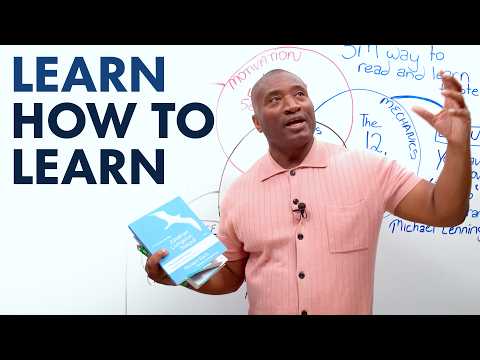
All right, so, you'll notice I have what's called a Venn Diagram. A Venn Diagram is intersecting circles, and what they say is here, here, and here, where they all come together, the intersection, is where the final result will be, what they all have in common. In this case, it's E's Reads. So, E, pick these first three books for you. I think he's got something for you.
So, let's start with the first one. The first book is Jonathan Livingston Seagull. This book, it's been out for a while. It came out in the 1960s... Well, it was written in the 1960s, published in 1970 by this gentleman, Richard Bach. Okay? It's a book that asks you, and says you need to see a bigger vision of yourself. What he says is that we don't see who our true selves are, and we have a little vision, and we stay small. But if we can expand that vision to see who we truly are, we are capable of the most incredible things. Okay? This is your "why", and he said you need a big enough "why" to get you off of your chair, off of your couch, out of your house to do something, to change. Yeah?
So, this was done in the... Written in the 1960s, published in 1970. It's about freedom. Right? It's self-discovery, pushing your boundaries, and it's become the greatest version of yourself. So, whatever you see in the mirror, imagine if you could be that superhero or that super athlete. Right? You could be... I don't know. I don't watch soccer, really, so I'm not going to make up any names. You know, I remember Pele, so you could be Pele. Uh-oh, I'm dating myself. Okay. Anyway, he also says that you can be a rebel with a cause, and you want to say... What does that mean, rebel with a cause? Well, as he's saying you could become the best version of yourself, to rebel or be a rebel, which is the noun, "rebel" is to go against, you will go against what society is saying you should be, and you need to be an outcast. That means someone outside in order to have the freedom to develop yourself, because in society we play small and we don't get to see how great we can be. Okay?
So, in this book, he doesn't use humans. He uses seagulls, and what's brilliant is half of the book is pictures of seagulls. Seriously. But it's really cool because the pictures do have meaning. […]