Video Description
Want faster progress in speaking English? Learn how asking the right questions helps you listen better, learn more, and create stronger connections with others. Most people try to speak more, but I’ll show you why asking better questions is the smarter strategy: Discover the mindset and practical question types that get people talking and help you learn English naturally. Questions activate your brain, create trust, and slow down speech so you can process language more clearly. You’ll see why humility matters when you ask, how to use clarification and follow-ups to deepen understanding, and how simple frameworks like KWL help you plan conversations that teach you new language. This is for intermediate and advanced learners who want to turn everyday chats into real practice and build stronger social and professional relationships in English. https://www.engvid.com/speak-less-ask-more-use-questions-to-improve-your-english/
Watch the next lesson in this course: https://www.youtube.com/watch?v=RgjUjpAyB2M&list=PL1MxVBsQo85qLby7rrLVVLNlWMLYoLjJZ&index=2
In this lesson:
0:00 Introduction
1:21 Change passive speaking to active questions
2:57 Questions build relationships
7:21 Why ask questions?
9:02 Engage your brain
10:33 Be humble
11:57 Clarify
13:10 Empower
14:45 Tip #1
15:15 Tip #2
15:58 Invest in loss
Transcript:
Hey, James from engVid. This video is going to be a little different than my normal videos. It's part of a four-part series in which we're going to look at communication in its totality, or in its big form. Okay? And we're going to show how speaking, reading, writing, and listening work together, so make sure you watch the other ones; they go together. And right now, I'm going to go to the board and start with our first lesson. Speaking. Speaking. Ah, speaking. And look, Mr. E is here to tell you that speaking is an important part of language. We say "acquisition" to get language, because in order to communicate, you need to speak and to listen. Right? They go together. Mr. E is telling you that speaking takes up 25-30% of language usage in a day, so you spend 25-30% of your day speaking more than, you know, 10% for, I believe, writing, 10-15%, but we'll get to that.
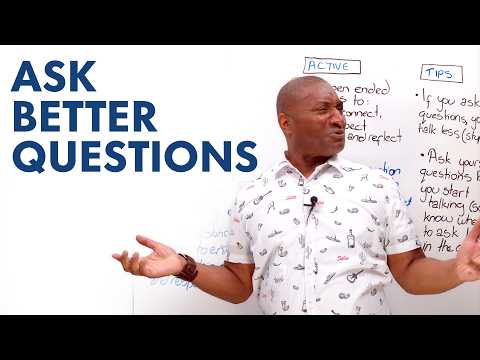
In this lesson, we're going to talk about the most important part of what I think you want to do when speaking in order to learn the most in language. Okay? And it's not speaking; it's actually questions. You want to learn to ask questions in order to improve your speaking and your communication ability. And let's go to the board to find out why. Well, most people want to speak because they want airtime. They think if they're not speaking, they're not being taken seriously or they're not important, and it's the person who's speaking who has all the power. Yes and no. Some people are just stupid, and they talk for the sake of stupid. You don't want to be that one. When you want to speak, you want to learn something or inform people. Okay? And the best way to do that is to start by questions. When we talk about... This is what we... Yeah, here, when I say "passive". For some people, speaking is your mouth is open, but no one's home. They're talking and they've got lots to say. It may not be informed, it may not be well thought out, it may not even be clear, and it's confusing for people, but they feel good because they're speaking. I want to change that, and that's kind of passive; it's just my mouth is open, I speak. I wanted to make it active, and the act of using questions is what makes it active. Right? Because when you use questions, we have... We ask open-ended questions. What does that mean? We don't say... Ask questions where it says "yes" or "no". We ask a question where the person has to speak more, or we say "elaborate", and as they do that, they give us more information so we can communicate more effectively with them. Right? We use questions to clarify, like, what do you mean, connect. Did this happen to you? This happened to me. Right? Show respect. Well, what does that mean to you? Right? And empathy and reflect, to think about it. So, by asking questions, we can have all of this, which is different than just speaking for the sake of speaking. All right?
I want to talk about a book, why I chose speaking as the cornerstone for, you know, questions for the cornerstone of speaking, as opposed to just saying you can talk about this and that. I've got videos teaching you how to do small talk, how to ask questions and that, but I think it's important you have to understand the importance of questions so that you can utilize them to learn language, not just for better communication, which is what it's about. That's why you're learning a language, to communicate. But we want to do this so that we can actually get more out of our conversations and closer relations. Why is it important? […]