Video Description
They seem like really simple words, but you need to know EXACTLY how and when to use them, without even thinking about it. To do that, you need to learn the precise usage of the English demonstratives: this, that, these, and those. These small but powerful English words help you point to things and give important information about distance, number, and time. https://www.engvid.com/english-for-beginners-this-that-these-those/
Next, watch these beginner grammar lessons:
HOW, WHY, WHERE, and WHEN: https://youtu.be/DsFT8exiG5o
ON, AT, IN, and BY: https://youtu.be/sN5H7YTo_IQ
In this lesson:
0:00 THIS, THAT, THESE, THOSE – Demonstratives
0:45 this
1:34 that
2:27 these & those
3:20 time usage
5:16 2 tricks
7:11 Test: THIS, THAT, THESE, THOSE
Transcript:
Hey, do you know which way you're going? Hi. James from engVid. Today, I'm going to teach you demonstratives. These words, you have to know, they're sort of like articles, and if those two words, you're going, "What is he talking about?" This lesson definitely is for you. Okay?
So, an article is a baseline where it's "a" or "the", and they're used to describe things. Demonstratives are sort of like... This pen. See this pen? It's not a pen. It gives direction. A demonstrative points to something, and I'm going to teach you the four words we use to point to something that tells us time and distance. Okay? Let's go to the board.
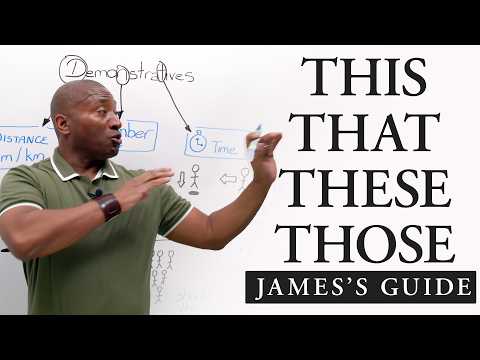
So, the demonstratives we're going to talk about are "this", "that", "these", and "those". And we're going to use it to use distance, number, and time. I'll show you how. When we want to talk about something that's close to us, and that's the basic essence of these words, it's about something being near or far. Okay? And I'll show you how we can use that idea of "near", which is close, and "far" to talk about time, distance, and number.
Now, distance. If something is close to you, like right beside you, you're going to say "this". Okay? Notice how it's... The circle is underneath, so I say "this pen". The pen is going to be close to me, in my hand, or I can actually touch it. "This". All right? Now, when I use the word "that", "that" is far away. Notice the arrow goes away. "That" is "that". So, we can say "this" is for things near or close to us, while "that" is for things far or away from us. And that's how we used it in distance. How far is it to my house? My house is that way. I'm just going to say it's a distance away. Or is this your house? And the house is probably right in front of me. Distance. Far or close.
Now, we're talking about far or close, let's move to the next thing. You notice I have "one" or I have "many". That's because we want to be able to use these words to talk about things that are in the ones. So, "this" or "that" is for single things. Okay? While "these", and these are the plural words, or "those" are for plurals. So, this marker, or if I were to do this and go "these markers", because they're far away, that would tell you distance, right? Those markers are far away, these markers are with me. Notice they are multiple, or many. Or, just in case you didn't see the beautiful colour choices I have, and you say "Why only blue or black when you have orange or red?" Another day. Or this marker that's close to me, or that marker far away. So, we can use this to tell us there is more than one single object, or more than one object.
So, we've covered distance, and we've covered number. Number. Really interesting words, simple, but full of information. So much so that we can actually use these words to talk about time. "Time", "pocket watch", "time". How can this talk about time? We know it talks about distance. Well, it has the same idea. You remember I said "this is near"? Well, when we talk about this, right, we're saying this. We're saying present tense. So, this time I'm going to do it right. Right now, present tense. But if we want to talk about the future or the past, we can use "that". So, someone could say to you, "Do you remember that time when we went to the beach?" That's in the past, because that is far away from us, not now. So, we can use our demonstrative to talk about time, and we can use it for the past or the present. I can use it for the future in saying, "Hey, I can't wait for our trip to Florida. That will be fun." That's not now; it's in the future. Right? Or I can say, "This is the best time of my life, and I'm talking about right now." So, by using "this" and "that", "these" and "those", we can talk about, well, distance for "this" and "that". We can talk about time using "that" or "this", and we can use "number". These are "those". Cool?
So, you've used demonstratives to talk about three different things, and it's really four words. Not so bad, huh? […]